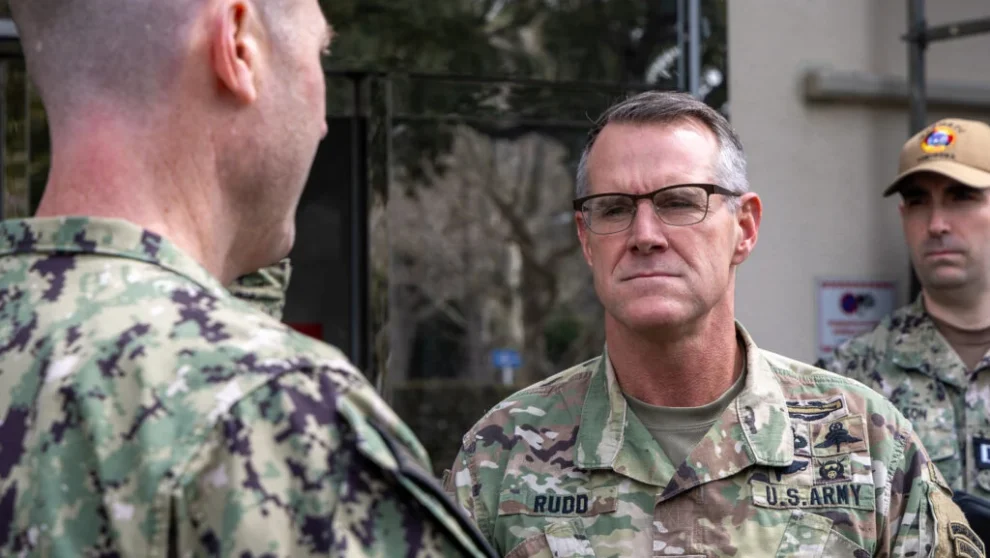
Lt. Gen. Joshua Rudd may be confirmed as soon as this week to lead US Cyber Command and the National Security Agency. And when that happens, the US military and intelligence community’s premier cyber offices will be led by a relative outsider — for better or worse.
Over the last month, Breaking Defense spoke to nine former US officials who dealt closely with cyber operations or policy, to understand how the cyber community is viewing the three-star with no specific cyber experience but a long special operations pedigree stepping into the role.
The consensus: A lot of trepidation, but with a few voices expressing hope that Rudd’s apparent strengths as a leader, and the presence of deputies with deep stronger technical expertise, will overcome any shortcomings.
One former military cyber operator said that the “sentiment [at NSA/CYBERCOM headquarters] at Fort Meade seems to be one of cautious pessimism,” fueled both by Rudd’s thin cyber background and questions over why he was chosen and what he intends to do.
But a former military cyber official said that while they understood Rudd’s nomination could feel like a “what the frick?” choice to some when there are plenty of senior cyber officials to choose from, technical ability is not always what matters at this high of a level.
“By all accounts, Josh Rudd has proven himself at the tactical, operational, and strategic level, under some very stressful conditions, including combat, obviously, to be able to lead,” the former official, who like others spoke on the condition of anonymity, told Breaking Defense. “That’s the good news. I mean, that’s fundamentally the most important thing.”
For his part, Rudd, currently the deputy commander of US Indo-Pacific Command, argued along similar lines during his confirmation hearings in January when questioned about his credentials.
“My prior leadership positions in special operations and joint task forces have honed my ability to lead multidisciplinary teams, manage complex operations, assess risk, and build the strong relationships with allies and partners that are essential to prevailing in strategic competition,” he said in response to written questions to senators as part of his confirmation.
He also noted that his job at INDOPACOM has exposed him to plenty of cyber operations.
“As the current Deputy Commander of U.S. Indo-Pacific Command (USINDOPACOM), I have been responsible for integrating operations across all domains — including cyberspace — to reinforce deterrence and prepare to fight and win if deterrence fails. This role has given me firsthand insight into the operational needs of the warfighter and the critical importance of synchronizing cyber effects with kinetic and non-kinetic capabilities,” he said.
The Caution Of The Critics
Four sources, all no longer in their cyber-related positions, said those in the cyber community are happy the Trump administration has finally nominated someone to helm both organizations. The top roles at each have remained leaderless since Gen. Timothy Haugh was fired without a public justification in April 2025. That 10-month gap has created challenges for the organizations and morale issues.
Those sources also said they’ve been hearing consternation because Rudd is an unknown, at least in the cyber world. A third former official said they’ve heard frustration about having a “shooter” become head of CYBERCOM.
Three of those who spoke to Breaking Defense maintained it would be unheard of for a someone outside the special operations world to be chosen to lead special operations forces, for example. Haugh and his predecessor, Gen. Paul Nakasone, both had years of experience in senior cyber positions before taking on the top job, and both were lauded as the right people to lead the organizations at the right time.
There is worry that Rudd’s so unfamiliar with cyber that he may not know how to create a vision and hold his staff to account for its execution, according to some that spoke to Breaking Defense. While Rudd’s SOCOM roles would have given him some familiarity with the intelligence community and exposure to unique capabilities related to signals intelligence, many who spoke to Breaking Defense indicated the NSA role especially will likely be more of a challenge given its global and complex intelligence mission.
However, two former military cyber personnel acknowledged a history of military cyber forces drawing from people outside of that community, given cyber’s relative infancy in the department.
The ex-operator said there’s also lingering concern about what they saw was “massive damage” done by other Trump appointees elsewhere in government.
“That it is driving pessimism about why [Rudd] was chosen and what he intends to do,” the ex-operator said. “Both organizations [NSA and CYBERCOM] are reeling from the mass talent exodus over the last year, so this just adds to the stress of the remaining workforce.”
In his advance policy questions to Congress as part of his nomination, Rudd said his priorities will be ensuring the command can fight and win wars and to execute the mission in strategic competition. He wrote he plans to execute a 90-day review and, pending the results, will seek to orient operations, planning, and capability development for enduring homeland defense and the threat posed by China, deepen the integration of cyber effects with combatant command plans and accelerate modernization and readiness.
Some changes may already be underway. DoD recently unveiled the implementation plan for its CYBERCOM 2.0 effort, which aims to improve how the department provides trained and ready forces to the command, with a focus on improving the mastery of cyber warriors and specialization.
When asked for comment on the choice and relative lack of experience in the digital domain, the White House pointed to Rudd’s congressional testimony about his long prior experience working with NSA and CYBERCOM as a consumer and integrator of their capabilities.
Outsider As A Strength, And A Deputy To Lean On
On the other hand, three sources noted that Rudd’s background and outsider aspect could pose strengths for the two organizations he’s set to lead.
For example, they said, he’s a proven warfighter with a good track record. Those types of combat leaders are typically better at strategic thinking and planning, having come from combat arms their entire career, integrating kinetic and non-kinetic effects across all domains.
Having an outsider can also benefit the organization in some cases to challenge the status quo, interrogating longstanding institutional biases. A leader without any biases being able to look at things with fresh set of eyes and ears and ask the right questions can be extremely beneficial, the former official said.
Another former military cyber official said that it’s not totally uncommon for operators to lead certain roles in the services such as maintenance, support or acquisition, especially if there is a deputy deeply steeped in the organization with expertise. On Jan. 30, the Senate confirmed Lt. Gen. Lorna Mahlock as CYBERCOM’s deputy commander, someone with rich background at both CYBERCOM and NSA.
Additionally, the Trump administration’s pick of Tim Kosiba to be deputy director of NSA will be a boon for Rudd at NSA, sources said.
Kosiba is a 30-year veteran of the intelligence community, much of it at operational levels in the NSA, including a stint working as the technical director for the Requirements and Targeting Office at the NSA’s elite hacker unit known as Tailored Access Operations.
Ultimately, how Rudd does in his role may be difficult to know for a long time, as CYBERCOM and the NSA are secretive organizations by nature. Another former operator said that essentially, no news will be good news.
The ultimate test will be how Rudd evolves the organizations to where they need to go and at the rate they need to go.
“Any organization is resistant to change and that means leadership — he’s got that in spades — but it also means being able to dig in to those next-, second-, third-level details, to be able to bring people along and get them to buy into that change. And that’s going to be the challenge,” one source said.